
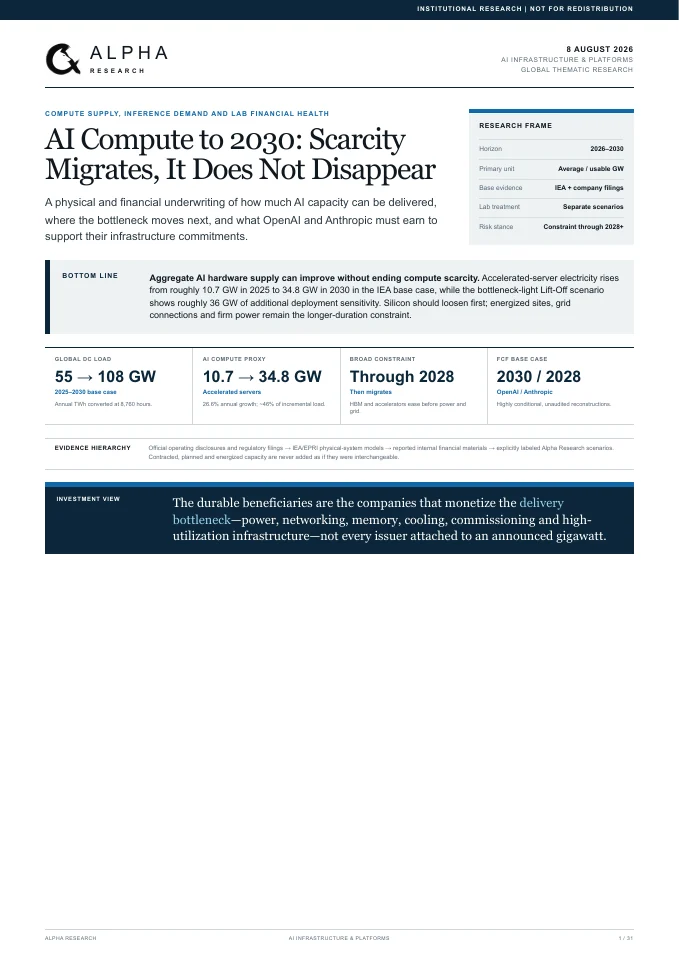
AI Compute to 2030: Scarcity Migrates, It Does Not Disappear
A physical and financial underwriting of how much AI capacity can be delivered, where the bottleneck moves next, and what OpenAI and Anthropic must earn to support their infrastructure commitments.
General research, not investment or trading advice or trade signals. Capital is at risk. Read the risks & conditions ↗
Opening the original PDF…
Original document · PDF · Scroll to read, or choose a page above.
General research, not investment or trading advice or trade signals. Capital is at risk. Read the paper’s risks and conditions before relying on the view. Holdings are those disclosed at the source date and may have changed.
Read this paper's risks & conditions ↓Report summary
Where AI compute supply could get stuck next: integration, energized sites and firm power. The question is whether usable capacity produces high-margin revenue before fixed commitments overwhelm cash generation.
Where supply is constrained
The paper follows the constraints from HBM, packaging and accelerators to networking, cooling, commissioning and power. Announced, contracted, energized, usable and average capacity refer to different things and cannot simply be added together.
What the capacity needs to earn
OpenAI and Anthropic are examined through capacity, revenue, cash generation and funding scenarios. The private-lab figures are uncertain reconstructions rather than audited accounts. Revenue per GW is a way to test the demands on the business, not a valuation multiple.
What would support an investment case
The paper looks for utilized supply, backlog conversion, better service availability and rising cash gross profit per unit of delivered capacity. Its preferred themes are not security-level ratings, price targets or ticker allocations.
Summary sources: p. 1, p. 2, p. 6, p. 7, p. 15, p. 16, p. 23, p. 24, p. 27, p. 28, p. 29, p. 30, p. 31. Page references use the physical PDF page numbers.
Risks & conditions
Read any potential return alongside the paper's risks, conditions and limitations.
The thesis breaks if usable capacity grows faster than paid inference while utilization and margins weaken and commitments keep rising: scarcity can become stranded-capital risk. Source: p. 27, p. 29.
Commissioning delays, idle accelerators, inference price compression, slow breakeven and higher financing costs can undermine the economics before contracts reprice. Source: p. 29.
Orders may become speculative inventory. Supplier integration, delayed interconnection, weak tenant quality, refinancing, permitting, power intervention and export controls can change which bottlenecks are investable. Source: p. 28, p. 29.
The private-lab financial cases are reconstructions with explicit uncertainty, and the report provides no security ratings or price targets. Company mentions do not establish portfolio positions. Source: p. 15, p. 16, p. 23, p. 24, p. 30, p. 31.
Source record
The cover states 8 AUGUST 2026. No publication clock time or timezone is printed. Source: p. 1.
Original filename: alpha-research-ai-compute-2030-august-2026.pdf
Imported:
PDF SHA-256: fb83e187056e3c847ed0a880091f7376cf8ee941e53c343f4e0933fd7b4490aa
Current assessment
Agentic intensity strengthens the demand case; returns remain conditional.
The October paper explicitly says the prior compute-consumption model was too conservative as agentic workflows increase usage intensity. This develops August’s usable-capacity framework, especially the relationship between useful inference demand and productive compute supply. The author’s demand assumption strengthens; investment returns remain unproven. October retains financing, depreciation, utilization, price-pressure and capital-allocation risks. This editorial comparison establishes no allocation or transaction.
Review based on evidence through . The original paper is unchanged. This review does not record a trade.
AI Infrastructure Is Moving From an Adoption Cycle Into a Utilization Cycle · p. 4, p. 16, p. 17, p. 18
Later demand revision and retained infrastructure-return tests. The October source specifies a month only; this entry records today's comparison, not an inferred publication day.
Thesis history
AI Compute to 2030: Scarcity Migrates, It Does Not Disappear
Where AI compute supply could get stuck next: integration, energized sites and firm power. The question is whether usable capacity produces high-margin revenue before fixed commitments overwhelm cash generation.
Agentic intensity strengthens the demand case; returns remain conditional.
The October paper explicitly says the prior compute-consumption model was too conservative as agentic workflows increase usage intensity. This develops August’s usable-capacity framework, especially the relationship between useful inference demand and productive compute supply. The author’s demand assumption strengthens; investment returns remain unproven. October retains financing, depreciation, utilization, price-pressure and capital-allocation risks. This editorial comparison establishes no allocation or transaction.
StrengthenedReview based on evidence through . The original paper is unchanged. This review does not record a trade.
AI Infrastructure Is Moving From an Adoption Cycle Into a Utilization Cycle · p. 4, p. 16, p. 17, p. 18
Later demand revision and retained infrastructure-return tests. The October source specifies a month only; this entry records today's comparison, not an inferred publication day.
Adding the paper to this library does not change its source date. Later reviews use their actual dates and link to the supporting research. Neither records a portfolio trade.
Equities research timeline
Published equities reports appear here in date order. A change in this thesis is recorded in a separate, dated assessment with the evidence behind it.
The week uncertainty clears
The case for a tactical Nasdaq bottom during the 27–31 July earnings and macro window. Friday’s close is the confirmation test; the date alone is not enough.
Framework · Conditional bottomAI Compute to 2030: Scarcity Migrates, It Does Not Disappear
Where AI compute supply could get stuck next: integration, energized sites and firm power. The question is whether usable capacity produces high-margin revenue before fixed commitments overwhelm cash generation.
Framework · Selective thematic frameworkMain Full-Risk Portfolio
A full-risk, long portfolio based on earnings conversion and valuation normalization, with position weights, valuation scenarios and the conditions that could undermine the thesis.
Deep dive · Long portfolioAI Infrastructure Is Moving From an Adoption Cycle Into a Utilization Cycle
What to watch ahead of hyperscaler earnings: agentic usage, cloud demand and whether new productive compute capacity can turn that demand into revenue and returns.
Deep dive · Positive demand thesis; conditional returnsThe original PDFs and dates are unchanged. Where a source gives only a month, reports with overlapping dates cannot be put in a definite order. A new report in this category does not confirm the thesis or record a trade.
Explore equities researchConnections between the papers
These reading links point to shared drivers or later developments, with page references to both original PDFs.
From earnings conversion to delivered compute
July separates strong cloud demand from the timing of equity cash returns. August develops the physical side of that question: usable capacity, utilization and cash gross profit must improve together. The later framework does not establish whether the July tactical bottom was confirmed.
The week uncertainty clearsThis paper: p. 2, p. 27, p. 28, p. 29 · Linked paper: p. 4, p. 7, p. 12
Applying the conversion framework to a portfolio
August tests whether scarce infrastructure becomes profitable utilized capacity. September applies the capital-to-demand-to-revenue-to-cash-flow chain to a concentrated equity portfolio and states the shared AI-capex risks. A thematic connection does not imply a new purchase or allocation change.
Main Full-Risk PortfolioAgentic intensity extends the demand question
October explicitly raises the author’s prior assumption about compute consumption as agentic work increases usage intensity. The usable-capacity and capital-return tests from August remain relevant: rising demand alone does not demonstrate adequate returns after depreciation, financing and price pressure.
AI Infrastructure Is Moving From an Adoption Cycle Into a Utilization CycleThis paper: p. 27, p. 28, p. 29 · Linked paper: p. 4, p. 16, p. 17, p. 18
A related paper can add context without confirming a forecast. These links and reviews do not record model-portfolio trades.